PJM Capacity Auction Procures 138,318 MW of Generation Resources as Work Continues To Address Growing Electricity Demand
PR Newswire
VALLEY FORGE, Pa., July 14, 2026
Price Comes in at FERC-Approved Cap, Down 2.5%; Total Capacity Cleared Is 6,831 MW Short of Reliability Requirement
VALLEY FORGE, Pa., July 14, 2026 /PRNewswire/ -- PJM Interconnection today announced the results of its 2028/2029 Base Residual Auction, which secured 138,318 MW of unforced capacity generation (UCAP) and demand response to meet projected electricity needs for more than 67 million people across 13 states and the District of Columbia.
Regions under the Fixed Resource Requirement (FRR) acquired an additional 10,864 MW in UCAP, for a total of 149,182 MW in UCAP available to serve forecasted peak electricity demand, plus a reserve margin. UCAP represents a generation resource's maximum output adjusted for its estimated ability to reliably perform at times of highest system risk.
Capacity Price Comes in at the Cap of $325, Down 2.5%
In coordination with the governors of all 13 PJM states and the Federal Energy Regulatory Commission, PJM established a price cap and floor, or collar, for four capacity auctions to protect both consumers and investors from market volatility. This was the third consecutive auction with the price collar.
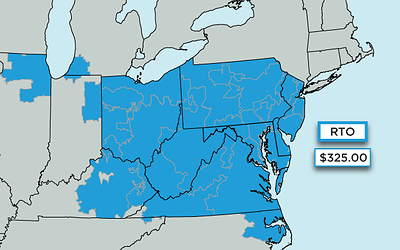
The price came in at the FERC-approved cap, $325/MW-day (UCAP) for the entire PJM footprint, a 2.5% decrease from the 2027/2028 Base Residual Auction cap of $333.44/MW-day. The cap is calculated using the accredited capacity of the PJM reference resource.
The cleared supply procured in the auction times the clearing price totals $16.4 billion. The total value does not equate to the total cost to load because load that is hedged through self-supply or bilateral contracts is not exposed to the clearing prices in the auction.
Resource Level Short of Standard
The capacity of the resources procured in the auction, plus FRR resources, is short of PJM's reliability requirement by 6,831 MW, meaning that the committed supply is less than what would be required to meet the one-event-in-10-year reliability standard.
This shortfall was not unexpected given the conditions PJM has been observing, including a shortfall of approximately 6,500 MW in the previous capacity auction (for the 2027/2028 Delivery Year). These most recent auctions were the first in PJM history in which the entire RTO fell short of the reliability requirement. PJM plans to seek FERC approval to hold a special "Backstop Procurement" in September to help address the near-term shortfall in electricity supply.
Such a shortage does not necessarily mean that the PJM system will be unable to serve load reliably in the delivery year; it means that PJM would have to operate with slimmer reserves and a greater level of risk. PJM continues to hold a reserve margin of 14.7% for the 2028/2029 Delivery Year.
PJM Working To Balance Supply/Demand
"These auction results show that demand for electricity continues to grow faster than electricity supply," said David Mills, PJM President and CEO. "At the same time, PJM recognizes how this supply-and-demand imbalance impacts the reliability of the system and costs for consumers. We are working with government and industry leaders on multiple fronts to restore that balance by bringing on new generation as fast as possible and managing the growth of new load on the grid."
While the price cap and floor may reduce volatility, they do not solve the underlying supply-demand imbalance. Addressing that challenge requires bringing more resources onto the system to meet the pace of demand growth.
PJM's actions to increase supply and manage demand include:
- Clearing the generation interconnection queue backlog and implementing our new streamlined cycle process, including a collaboration with Google's Tapestry to leverage AI to reduce study timelines
- Planning a Reliability Backstop Procurement to address near-term reliability needs and allocate the costs consistent with state preferences
- Developing "Connect and Manage" frameworks that allow large new loads, such as data centers, to connect to the system but operate flexibly when needed to limit disruptions to other consumers
- Creating a FERC-approved, temporary Expedited Interconnection Track for up to 10 state-sponsored, shovel ready, high-capacity generation projects that could come online quickly to address short-and long-term supply needs
- Maximizing the performance and availability of existing generation resources
- Moving forward with stakeholders on long-term market reform as outlined in PJM's Powering Reliability Through Market Design (PDF) report
PJM plans to submit filings with FERC on its Reliability Backstop and Connect and Manage proposals in the coming weeks.
In addition to the above actions, on June 9 PJM began facilitating new bilateral, long-term agreements between large load customers and generation providers. These contracts – often spanning 10 years or more – would allow buyers to secure supply from new generation, storage or demand-side resources. PJM issued a Request for Proposal to support this matching process, while market participants remain free to pursue such bilateral arrangements independently.
"All of these initiatives are critical to keeping the lights on while allowing states to protect their everyday electricity customers," Mills said. "PJM will continue to collaborate with our state and federal partners and take decisive action to match electricity supply to the demands of the growing economy."
Auction Statistics
Wholesale capacity acquired through the auction accounts for a fraction of wholesale electricity costs; other contributing elements include the daily cost of power and maintenance and expansion of the transmission system. Wholesale costs make up a portion of retail electricity bills.
The RPM forecasted peak load for the 2028/2029 Delivery Year is approximately 2,000 MW higher than the forecast used for the 2027/2028 capacity auction.
The supply mix for RPM cleared and FRR committed resources in this auction in UCAP includes: 46% natural gas, 20% nuclear, 18% coal, 5% demand response, 4% hydro, 2% wind, 2% oil and 1% solar. Natural gas increased 5,639 MW UCAP primarily from an increase in accredited UCAP factors, coal units that converted to natural gas and units that participated in this auction that did not participate in the last auction. Coal decreased 2,941 MW UCAP primarily from retirements or conversion to natural gas. Solar increased 651 MW UCAP from new or planned resources.
Supply offered into the 2028/2029 BRA increased 3,447 MW (UCAP), from 136,148 MW in the 2027/2028 BRA to 139,595 MW in the 2028/2029 BRA.
The auction cleared 525 MW UCAP of new generation and generation uprates. The total amount of cleared capacity increased by 3,733 MW UCAP, from 134,585 MW in the 2027/2028 BRA to 138,318 MW UCAP in the 2028/2029 BRA.
The total amount of supply in the PJM service area increased from 200,994 MW to 202,288 MW, or an increase in the total amount of supply by 1,294 MW installed capacity, or ICAP. ICAP represents the total amount a generation resource can produce; UCAP represents its accredited capacity that can be offered in the capacity auction.
This auction also saw the continued trend of the addition of large data center loads to the load forecast that forms the basis of the reliability requirement.
PJM remains focused on maintaining a transparent market framework that accurately reflects supply/demand conditions; streamlining interconnection processes; and working collaboratively with states, developers and industry to support solutions that can bring needed capacity online.
As is consistently the case with these capacity market auctions, market power mitigation protocols resulted in the application of limits to offer prices from existing generation under the Three-Pivotal Supplier Test. The next Base Residual Auction, which is for the 2029/2030 Delivery Year, is scheduled for December as PJM works toward returning to its three-year-forward planning cycle.
A detailed report of the results will be available on PJM's capacity market web page.
2028/2029 Capacity Prices
PJM Interconnection, founded in 1927, ensures the reliability of the high-voltage electric power system serving 67 million people in all or parts of Delaware, Illinois, Indiana, Kentucky, Maryland, Michigan, New Jersey, North Carolina, Ohio, Pennsylvania, Tennessee, Virginia, West Virginia and the District of Columbia. PJM coordinates and directs the operation of the region's transmission grid, which includes 88,417 miles of transmission lines; administers a competitive wholesale electricity market; and plans regional transmission expansion improvements to maintain grid reliability and relieve congestion. PJM's regional grid and market operations produce annual savings of $5 billion. For the latest news about PJM, visit PJM Inside Lines at insidelines.pjm.com.

 View original content to download multimedia:https://www.prnewswire.com/news-releases/pjm-capacity-auction-procures-138-318-mw-of-generation-resources-as-work-continues-to-address-growing-electricity-demand-302825613.html
SOURCE PJM Interconnection

