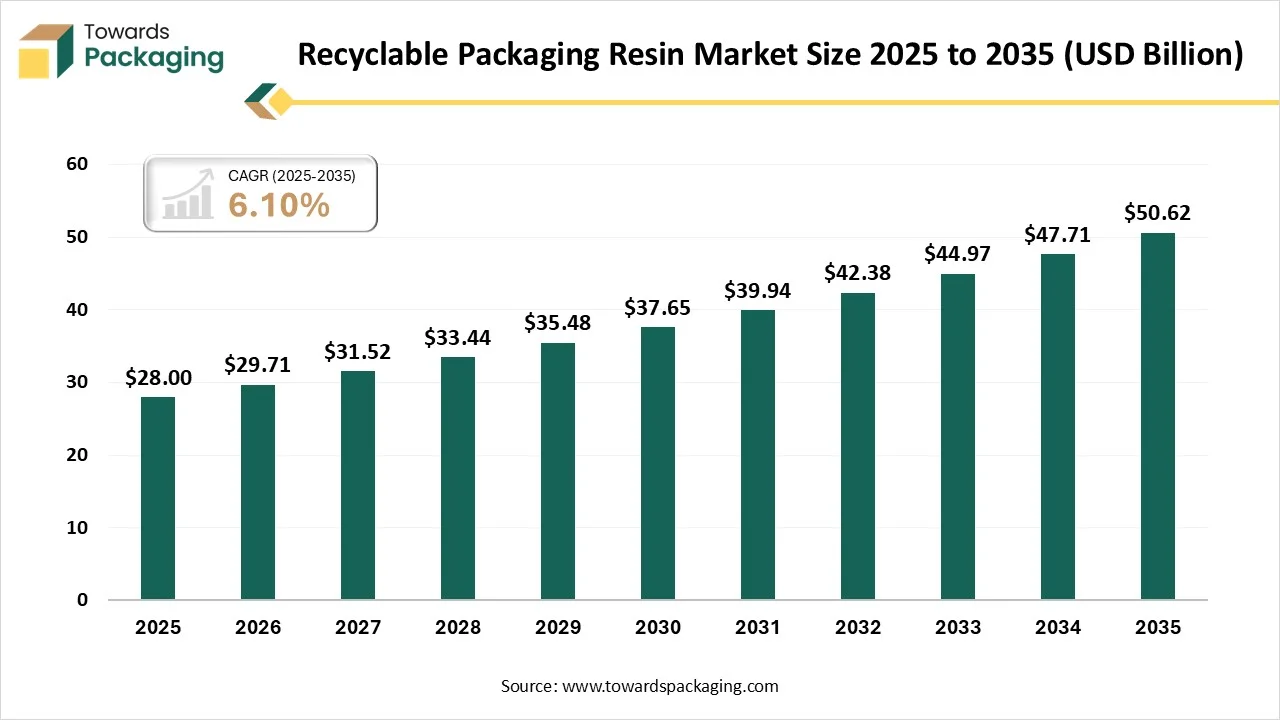
Ottawa, March 04, 2026 (GLOBE NEWSWIRE) -- The global recyclable packaging resin market size stood at USD 28 billion in 2025 and is projected to reach USD 50.62 billion by 2035, according to a study published by Towards Packaging, a sister firm of Precedence Research.
Request Research Report Built Around Your Goals: sales@towardspackaging.com
Why is the Recyclable Packaging Resin Market Gaining Strategic Importance?
Recyclable packaging resin refers to polymer materials designed to be reused or reprocessed into new products at the end of their life, reducing landfill waste and conserving resources. Its strategic importance is growing as brands and regulators push for sustainable supply chains, lower environmental impact, and compliance with recycling targets.
Demand for recyclable resins supports circular economy goals, drives innovation in material science, and helps companies meet consumer expectations for greener packaging solutions.
Private Industry Investments for Recyclable Packaging Resin:
Indorama Ventures: This global leader has invested heavily in recyclate capacity and closed-loop systems to secure its position in the recycled PET (rPET) resin market.
Circulate Capital: This venture firm has funded companies like Lucro Plastecycle and Dalmia Polypro to scale high-quality recycled resin production across emerging markets.
Samsara Eco: This startup secured significant Series A funding to scale enzymatic technology that breaks down plastic waste into virgin-quality resin building blocks.
Alpek S.A.B. de C.V.: The company acquired OCTAL for $620 million to integrate low-emission PET technology and meet the rising demand for sustainable packaging materials.
Plastic Energy: Backed by investors like Sealed Air, this firm builds chemical recycling plants that convert plastic waste into feedstock for new polymer manufacturing.
SIG Group: This packaging leader committed over $100 million to establish production facilities that utilize sustainable material streams for aseptic cartons.
What Are the Latest Key Trends in the Recyclable Packaging Resin Market?
Shift Toward Bio-based and Compostable Resins
Manufacturers are increasingly adopting bio-based and compostable resin alternatives derived from renewable sources such as plant cellulose, PLA, or sugarcane. These materials reduce reliance on fossil-based plastics, lower carbon footprints, and align with sustainability goals. They also address consumer demand for truly eco-friendly packaging that can break down naturally or be repurposed efficiently.
Innovation in Chemical Recycling Technologies
Chemical recycling processes, such as depolymerization and solvolysis, are gaining traction as they recover monomers from mixed and hard-to-recycle plastics. This enables the creation of high-quality recyclable resin with properties similar to virgin plastics. The trend is driven by investor interest and regulatory pressure to create closed-loop recycling systems for broader material streams.
Greater Use of High-Quality Post-Consumer Recycled (PCR) Content
Brands are increasing the percentage of PCR resin in packaging to meet sustainability commitments and reduce environmental impact. Higher-quality PCR materials enhance the durability, appearance, and performance of recycled packaging.
Enhanced Transparency and Resin Traceability
Supply chain traceability tools like digital watermarking and blockchain are being integrated to track resin origin and recycling outcomes. This trend improves accountability, verifies recyclability claims, and combats greenwashing. Enhanced transparency helps retailers and consumers make informed choices, and supports compliance with global mandates on recycled content and sustainable sourcing.
Collaboration Between Industry Stakeholders
Partnerships among resin producers, converters, consumer brands, waste management firms, and governments are strengthening to scale recyclable resin solutions. Collaborative initiatives aim to improve collection infrastructure, recycling efficiency, and standardization of recyclable formats. This collective approach accelerates innovation, reduces logistical barriers, and helps mainstream recyclable resins across product categories.
What is the Potential Growth Rate of the Recyclable Packaging Resin Industry?
The recyclable packaging resin industry is projected to expand at a steady and sustained pace as industries transition toward circular material systems. Growth is being supported by stricter environmental policies, increasing adoption of recycled polyethylene and PET resins, and stronger corporate commitments to reduce plastic waste.
Get All the Details in Our Solutions - Access Report Sample: https://www.towardspackaging.com/download-sample/5966
Regional Analysis:
Who is the leader in the Recyclable Packaging Resin Market?
Europe dominates the market due to its strict environmental regulations, including mandatory recycled content targets and extended producer responsibility frameworks. The region has a well-developed collection and recycling infrastructure, enabling higher recovery and reuse rates of plastic resins.
Strong sustainability commitments from major consumer goods companies, combined with active government support for circular economy initiatives, accelerate material innovation and adoption. High consumer awareness further strengthens demand for recycled and recyclable resin solutions across industries.
UK Recyclable Packaging Resin Market Trends
In the UK, the recyclable resin and sustainable materials sector is shaped by strong policy and industry collaboration. Government reforms like Extended Producer Responsibility and the Plastic Packaging Tax push producers to improve material recyclability and use more recycled content, driving innovation. Industry initiatives such as the UK Plastics Pact have significantly increased recyclable design and reduced problematic plastics in products.
How is the Opportunistic is the Rise of the Asia Pacific in the Recyclable Packaging Resin Industry?
Asia-Pacific is expected to be fastest growing region in the market due to strong manufacturing expansion, rising packaged goods consumption, and rapid growth in food, beverage, and e-commerce sectors. Countries such as China, India, Japan, and South Korea are strengthening plastic waste management rules and recycled content mandates.
Increasing investments in domestic recycling facilities, growing middle-class demand for sustainable products, and cost-efficient resin production capabilities are accelerating regional market expansion.
China Recyclable Packaging Resin Market Trends
In China, the market is advancing through strong governmental support for sustainable materials and waste reduction policies. The government’s focus on improving recycling infrastructure and stricter regulations on plastic disposal are encouraging manufacturers to use more recyclable and recycled resins. Rapid growth in e-commerce and consumer goods production is increasing demand for recyclable solutions.
More Insights of Towards Packaging:
- Pharmaceutical Temperature Controlled Packaging Solutions Market Size, Trends, Segments, Companies, Competitive Analysis, Value Chain & Trade Analysis 2025-2035
- E-Commerce Packaging Market Size, Share, Trends, Segments, Regional Outlook (NA, EU, APAC, LA, MEA), and Competitive Analysis 2025-2035
- North America Stick Packaging Market Size and Segments Outlook (2026–2035)
- Hot Drinks Packaging Market Size, Trends and Regional Analysis (2026–2035)
- Recyclable Packaging Market Size, Trends, Key Segments, and Regional Dynamics with Manufacturers and Suppliers Data
- Reusable Packaging Market Size, Trends, Share, Segments, and Regional Insights (NA, EU, APAC, LA, MEA)
- U.S. Molded Pulp Packaging Market Size, Trends and Competitive Landscape (2026–2035)
- Vaccine Storage Packaging Market Size, Trends and Segments (2026–2035)
- Intelligent Packaging Market Size, Trends and Segments (2026–2035)
- Plastic Packaging Market Size and Segments Outlook (2026–2035)
- Lightweight Industrial Corrugated Packaging Market Size and Segments Outlook (2026–2035)
- Dairy Product Packaging Market Size and Segments Outlook (2026–2035)
- Refillable Packaging Market Size, Trends and Regional Analysis (2026–2035)
- U.S. Black Rigid Plastic Packaging Market Size, Trends and Segments (2026–2035)
- North America Yogurt, Cheese & Meat FFS Packaging Market Size, Trends and Segments (2026–2035)
- Automotive Parts Packaging Market Size, Trends and Competitive Landscape (2026–2035)
- Form-Fill-Seal Packaging Market Size, Trends and Segments (2026–2035)
- Alcoholic Beverage Packaging Market Size and Segments Outlook (2026–2035)
- PP Rigid Plastic Packaging Market Size, Trends and Segments (2026–2035)
- Protein Packaging Market Size, Trends and Regional Analysis (2026–2035)
- Personalized Packaging Market Size, Trends and Segments (2026–2035)
Segment Outlook
Resin Type Insights
The polyethylene segment holds a dominant position in the recyclable packaging resin market due to its wide recyclability, cost efficiency, and strong performance characteristics. High-density and low-density polyethylene are extensively used in films, bottles, and rigid containers because they are lightweight and durable. Established recycling streams for polyethylene, especially in developed regions, support large-scale recovery and reuse, making it a preferred resin for circular material strategies across industries.
The polyethylene terephthalate (PET) segment is expected to grow at the fastest rate in the market because PET is widely accepted in recycling systems and maintains high material quality after reprocessing. Its clarity, strength, and barrier properties make it ideal for bottles and food packaging. Strong consumer demand for recycled PET, especially in beverage and personal care products, is driving greater adoption and investment in PET recycling infrastructure.
Packaging Type Insights
The rigid packaging segment dominates the recyclable packaging resin market because it benefits from well-established recycling systems and structural advantages that improve material recovery and reuse. Rigid formats such as PET and HDPE bottles, tubs, and jars are widely accepted by curbside and industrial recycling programs, allowing high post-consumer recycled content integration without losing performance.
The flexible packaging segment is expected to grow at the fastest CAGR in the market because manufacturers are developing mono-material and recyclable films that are easier to process and reuse, addressing environmental regulations and brand sustainability targets. Rising demand from food, beverage, and e-commerce sectors for lightweight, durable, and eco-friendly formats is accelerating adoption.
End-User Insights
The food and beverage segment dominates the recyclable packaging resin market because it relies heavily on high-volume packaging formats such as bottles, trays, caps, and containers made from recyclable PET and polyethylene. Strict food safety regulations require materials that maintain purity even after recycling, increasing demand for certified recycled resins. Additionally, major beverage and packaged food brands have committed to higher recycled content targets, driving continuous procurement of food-grade recyclable resins.
The pharmaceutical and personal care segment is expected to be the fastest-growing segment in the market due to escalating demand for sustainable, hygienic, and high-barrier packaging solutions. Stringent safety and quality standards require materials that preserve product integrity while supporting recyclability. Increasing consumer preference for eco-friendly health and beauty products is pushing brands to adopt recyclable PET and PE resins.
Source Insights
The virgin recyclable resin segment dominates the recyclable packaging resin market because it combines the consistent quality and performance of new resin with designed recyclability, making it easier for manufacturers to meet both product standards and sustainability goals. These resins offer reliable physical and chemical properties essential for food, beverage, and pharmaceutical packaging, and they integrate smoothly into existing processing and recycling systems, ensuring supply stability and broad industry acceptance.
The recycled resins segment is expected to be the fastest-growing segment in the market because expanding recycling infrastructure and stronger regulations are increasing the availability and acceptance of post-consumer and post-industrial recycled materials. Brands are under pressure to meet sustainability commitments and reduce plastic waste, leading to rising demand for high-quality recycled resins that can replace virgin materials in packaging.
Recent Breakthroughs in the Recyclable Packaging Resin Industry
- In January 2026, INEOS launched a new Recycl-IN polypropylene grade containing 70% recycled content for cosmetics and personal care applications. The resin is engineered to match the performance of virgin polymers while significantly increasing recycled material usage.
- In February 2026, Mamata Machinery introduced RecTech, a recyclable mono-material film solution showcased at PlastIndia 2026. The technology enables the replacement of multi-layer mixed-material structures with recyclable alternatives that are compatible with existing recycling streams. The launch supports extended producer responsibility compliance and advances practical recyclability in high-barrier flexible applications.
Top Companies in the Recyclable Packaging Resin Market & Their Offerings
Tier 1:
- Dow Inc.: Provides REVOLOOP™ resins with up to 100% PCR content and INNATE™ TF for mono-material, recyclable film structures.
- LyondellBasell: Offers the Circulen suite, featuring mechanically recycled, advanced recycled, and bio-based polymers.
- ExxonMobil: Utilizes Exxtend™ technology to create circular polymers from hard-to-recycle plastic waste for food-grade packaging.
- SABIC: Features the TRUCIRCLE™ portfolio, including certified circular, renewable, and mechanically recycled resins.
- BASF SE: Produces Ultramid® Ccycled® via chemical recycling and Epotal® ECO compostable adhesives for recyclable laminates.
- Borealis AG: Markets Borcycle™ recycled polyolefins and Bornewables™ bio-based resins for circular packaging solutions.
- TotalEnergies: Supplies the RE:clic range, focusing on high-performance mechanically and chemically recycled polymers.
- INEOS Group: Delivers Recycl-IN hybrid resins that blend high PCR content with virgin polymers to maintain material performance.
Tier 2:
- Braskem
- Eastman Chemical Company
- Covestro AG
- Mitsui Chemicals
- Chevron Phillips Chemical
- Formosa Plastics Corporation
- LyondellBasell
- DOW
- Amcor Plc
- Uflex Limited
- Berry Global Group, Inc.
- Amcor PLC
- Sonoco Products Company:
- Sealed Air Corporation
- Bemis Company (now part of Amcor)
- Mondi Group
- Coveris Holdings S.A.
- Uflex Limited
- Cosmo Films Ltd
Segment Covered in the Report
By Resin Type
- Polyethylene (PE)
- HDPE
- LDPE
- LLDPE
- Polypropylene (PP)
- Polyethylene Terephthalate (PET)
- Polystyrene (PS)
- Others (PVC alternatives, bio-based recyclable resins, blends)
By Packaging Type
- Rigid Packaging
- Bottles & Containers
- Trays & Tubs
- Flexible Packaging
- Films & Wraps
- Pouches & Sachets
By End-Use Industry
- Food & Beverage
- Personal Care & Cosmetics
- Pharmaceuticals & Healthcare
- Household & Industrial Chemicals
- E-commerce & Consumer Goods
By Source
- Virgin Recyclable Resins
- Recycled Resins (rPE, rPP, rPET)
By Region
North America:
- U.S.
- Canada
- Mexico
- Rest of North America
South America:
- Brazil
- Argentina
- Rest of South America
Europe:
- Western Europe
- Germany
- Italy
- France
- Netherlands
- Spain
- Portugal
- Belgium
- Ireland
- UK
- Iceland
- Switzerland
- Poland
- Rest of Western Europe
- Eastern Europe
- Austria
- Russia & Belarus
- Türkiye
- Albania
- Rest of Eastern Europe
Asia Pacific:
- China
- Taiwan
- India
- Japan
- Australia and New Zealand,
- ASEAN Countries (Singapore, Malaysia)
- South Korea
- Rest of APAC
MEA:
- GCC Countries
- Saudi Arabia
- United Arab Emirates (UAE)
- Qatar
- Kuwait
- Oman
- Bahrain
- South Africa
- Egypt
- Rest of MEA
Invest in Our Premium Strategic Solution: https://www.towardspackaging.com/checkout/5966
Request Research Report Built Around Your Goals: sales@towardspackaging.com
About Us
Towards Packaging is a global consulting and market intelligence firm specializing in strategic research across key packaging segments including sustainable, flexible, smart, biodegradable, and recycled packaging. We empower businesses with actionable insights, trend analysis, and data-driven strategies. Our experienced consultants use advanced research methodologies to help companies of all sizes navigate market shifts, identify growth opportunities, and stay competitive in the global packaging industry.
Stay Connected with Towards Packaging:
- Find us on Social Platforms: LinkedIn | Twitter | Instagram | Threads
- Subscribe to Our Newsletter: Towards Sustainable Packaging
- Visit Towards Packaging for In-depth Market Insights: Towards Packaging
- Read Our Printed Chronicle: Packaging Web Wire
- Get ahead of the trends – follow us for exclusive insights and industry updates:
Pinterest | Medium | Tumblr | Hashnode | Bloglovin | LinkedIn – Packaging Web Wire | Globbook | Substack | Bluesky | Justdial | Crunchbase | TrustPilot | Bizcommunity - Contact: APAC: +91 9356 9282 04 | Europe: +44 778 256 0738 | North America: +1 8044 4193 44
Our Trusted Data Partners
Precedence Research | Towards Healthcare | Towards Food and Beverages | Towards Chemical and Materials | Healthcare Webwire | Packaging Webwire | Precedence Research Insights
Towards Packaging Releases Its Latest Insight - Check It Out:
Sustainable Aerosol Packaging Market Size, Trends and Segments (2026–2035)
Poly-Woven Packaging Market Size, Trends and Segments (2026–2035)
Mono-Material Cosmetic Tubes Market Growth, Trends & Forecast (2025-2035)
U.S. Beer Packaging Market Size and Trend, Segment Outlook (2026–2035)
Cold Chain Packaging Refrigerants Market Size, Trends and Segments (2026–2035)
Packaging Adhesive Market Size, Trends and Regional Analysis (2026–2035)
Heavy-Duty Corrugated Bulk Boxes Market Size and Segments Outlook (2026–2035)
Next-Gen Paper & Fiber-Based Packaging Market Size, Trends and Regional Analysis (2026–2035)
Flow Wrap Packaging Market Size, Trends and Competitive Landscape (2026–2035)
India Molded Pulp Packaging Market Size, Trends and Segments (2026–2035)
Polyethylene Films Market Size, Trends and Volume (2026-2035)
Thin Wall Packaging Market Size and Segments Outlook (2026–2035)
Dunnage Packaging Market Size, Trends and Segments (2026–2035)
Liquid Packaging Market Size and Segments Outlook (2026–2035)
Food Packaging Market Size, Trends and Segments (2026–2035)
U.S. Seed Packaging Market Size and Segments Outlook (2026–2035)
Europe Pharmaceutical Glass Packaging Market Size, Trends and Segments (2026–2035)
Uncoated Paperboard For Luxury Packaging Market Size and Segments Outlook (2026–2035)
Consumer Packaged Goods (CPG) Market Size, Trends and Competitive Landscape (2026–2035)