GermStopSQ Field Study Shows 97.5% Lower Recoverable Microbial Burden on Treated High-Touch Surfaces in Long-Term Care Setting
Canada NewsWire
TORONTO, July 22, 2026
Real-world evaluation at a Toronto long-term care facility found the median number of colony-forming units recovered from surfaces treated with GermStopSQ was 40.5-fold lower than those treated with the facility's reference hydrogen peroxide disinfectant.
TORONTO, July 22, 2026 /CNW/ -- GermStopSQ Inc. today announced results from a clinical field evaluation conducted at a long-term care facility in Toronto, showing that high-touch surfaces treated with GermStopSQ carried substantially lower recoverable microbial burden than comparable surfaces treated with the facility's reference hydrogen peroxide disinfectant.
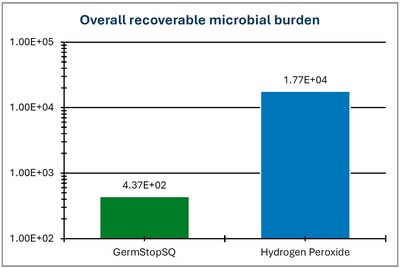
Across 29 surface samples analyzed by CREM Co Labs, GermStopSQ-treated surfaces showed a median recovery of 436.7 colony-forming units (CFU), compared with 17,701.9 CFU on reference-disinfectant surfaces. This represents a 40.5-fold, 97.5%, or 1.61-log₁₀ lower median recoverable microbial burden with GermStopSQ under real-world operating conditions.
The field evaluation compared GermStopSQ, a Health Canada-approved residual disinfectant with DIN 02548305, against a hospital-grade hydrogen peroxide reference disinfectant used under the facility's standard cleaning protocol. GermStopSQ was applied to eligible high-touch surfaces on the fourth floor, while the reference disinfectant was used on floors one through three. The study assessed washroom surfaces, public-area tables, and elevator touch panels over multiple sampling dates in June 2026.
"These findings are significant because they confirm in a real-world scenario the Health Canada claims for continuous disinfection," said Scott Shayko, CEO of GermStopSQ Inc. "In this occupied long-term care setting, GermStopSQ treatments kept the recoverable microbial load on high-touch surfaces much lower across the cleaning interval, supporting the value of residual surface disinfection in high-traffic environments."
The study found lower median CFU on GermStopSQ-treated surfaces compared with the reference disinfectant on every surface type sampled: 89.4 times lower for washroom surfaces, 21.9 times lower for table surfaces, and 8.9 times lower for elevator touch panels. CFU recovery from GermStopSQ-treated surfaces also remained well below the reference median at each post-application time point measured: 4, 12, and 16 hours after treatment.
Unlike conventional contact disinfectants, which act only at the time of application, GermStopSQ is designed to form an invisible residual coating on hard, non-porous surfaces after drying. GermStopSQ provides 24-hour hospital-grade residual disinfection, meaning it continues killing bacteria and human coronavirus 229E, even after repeated touching and rubbing.
The results of this field evaluation build on an earlier GLP efficacy study that resulted in Health Canada issuing GermStopSQ a Drug Identification Number (DIN) in 2025. Results should be interpreted as comparative field observations of recoverable microbial burden under real-use conditions.
About GermStopSQ Inc.
GermStopSQ Inc. develops innovative solutions designed to provide lasting germ protection. Its innovative technologies create cleaner, safer environments for families and communities around the world.
Website: germstopsq.ca

SOURCE GermStopSQ Inc.

