Chonnam National University Identifies Dual-Function Rice Gene That Boosts Drought Tolerance and Grain Yield
PR Newswire
JEOLLANAM-DO PROVINCE, South Korea, June 25, 2026
New findings reveal how a chloroplast gene helps rice withstand environmental stress
JEOLLANAM-DO PROVINCE, South Korea, June 25, 2026 /PRNewswire/ -- As climate change intensifies droughts and other environmental stresses, maintaining crop productivity has become a major challenge for global agriculture. Drought can impair chloroplast development, reducing photosynthetic efficiency and ultimately lowering crop yields. Despite the importance of chloroplasts in plant growth and productivity, the molecular mechanisms that link chloroplast development with stress responses remain poorly understood.
Now, a research team led by Professor Geupil Jang at Chonnam National University has identified a rice gene called OsFeSOD3 that plays a dual role in protecting plants from environmental stress while supporting chloroplast development. Their findings were published online on 17 December 2025 and appeared in Volume 24, Issue 4 (2026) of the Plant Biotechnology Journal.
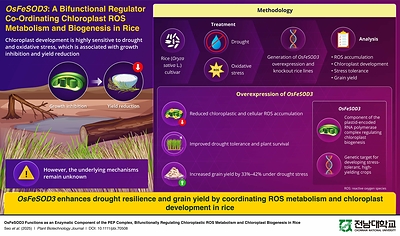
OsFeSOD3 encodes a chloroplast-localized iron superoxide dismutase, an enzyme known for detoxifying reactive oxygen species (ROS), harmful molecules that accumulate under stressful conditions. Using time-lapse visualization of cellular ROS dynamics and genetic analyses, the researchers found that drought-induced ROS accumulation begins primarily within chloroplasts before spreading throughout plant cells. Increasing OsFeSOD3 expression reduced chloroplast ROS levels, limited overall cellular damage, and enhanced drought tolerance in rice plants. "Chloroplast development is highly sensitive to environmental stresses such as drought, and this sensitivity is closely associated with growth inhibition and yield reduction under stress conditions," explained Professor Geupil Jang.
The study also uncovered an unexpected function of OsFeSOD3. Beyond its antioxidant role, the protein was found to act as a component of the plastid-encoded RNA polymerase (PEP) complex, a molecular machinery essential for chloroplast gene expression and development. Through direct interactions with other PEP-complex proteins, OsFeSOD3 helps regulate chloroplast biogenesis, linking stress protection with the maintenance of photosynthetic capacity. This dual functionality allows the gene to support both chloroplast health and plant survival under adverse conditions.
To assess the agricultural significance of this discovery, the team conducted field trials over two consecutive growing seasons. Rice plants engineered to overexpress OsFeSOD3 produced 33–42% higher grain yields under drought conditions than wild-type plants. The increase was largely driven by improved grain filling and greater grain numbers. In contrast, rice plants lacking OsFeSOD3, generated using CRISPR-Cas9 technology, developed severe chloroplast defects, exhibited albino leaves, and showed arrested growth, highlighting the gene's essential role in normal plant development.
The findings could have important implications for crop improvement. Plant breeders often face a trade-off between productivity and stress tolerance, as stronger stress defenses can sometimes reduce yield. By simultaneously enhancing stress resistance and supporting photosynthesis, OsFeSOD3 may help overcome this limitation. "Our findings suggest that OsFeSOD3 serves as a bifunctional regulator that coordinates chloroplastic ROS metabolism and chloroplast biogenesis in rice," concluded Prof. Jang.
As droughts, heat waves, and other climate-related stresses become more frequent, the ability to develop crops that remain productive under adverse conditions will become increasingly important. The researchers believe that understanding genes such as OsFeSOD3 could contribute to the development of climate-resilient, high-yield crops capable of supporting food security in vulnerable regions worldwide.
Reference
Title of original paper: OsFeSOD3 Functions as an Enzymatic Component of the PEP Complex, Bifunctionally Regulating Chloroplastic ROS Metabolism and Chloroplast Biogenesis in Rice
Journal: Plant Biotechnology Journal
DOI: https://doi.org/10.1111/pbi.70508
About Chonnam National University
Website: https://global.jnu.ac.kr/jnumain_en.aspx
Media Contact
Minji Son
82-62-530-5191
417526@email4pr.com
 View original content to download multimedia:https://www.prnewswire.com/news-releases/chonnam-national-university-identifies-dual-function-rice-gene-that-boosts-drought-tolerance-and-grain-yield-302809567.html
SOURCE Chonnam National University

